Amortizing Bond
FinPricing offers:
Four user interfaces:
- Data API.
- Excel Add-ins.
- Model Analytic API.
- GUI APP.

FinPricing provides valuation models for the following swaps:
An interest rate swap is an agreement between two parties to exchange future interest rate
payments over a set of future times. There are two legs associated with each party. Swaps are
the most popular OTC derivatives that are generally used to manage exposure to fluctuations in interest rates.
| 1. Interest Rate Basis Swap Introduction |
A basis swaps is an interest rate swap that involves the exchange of two floating rates,
where the floating rate payments are referenced to different bases. Both legs of a basis swap are floating but derived
from different index rates (e.g. LIBOR 1 month vs 3 month). Basis swaps are settled in the form of periodic floating interest
rate payments. They are quoted as a spread over the reference index. For example, 3-month LIBOR is frequently used as
a reference. Spreads are quoted over it.
A basis swap can be used to limit interest rate risk that a firm faces as a result of having different lending and
borrowing rates. Basis swaps help investors to mitigate basis risk that is a type of risk associated with imperfect
hedging. Firms also utilize basis swaps to hedge the divergence of different rates. Basis swaps could involve many
different kinds of reference rates for the floating payments, such as 3-month LIBOR, 1-month LIBOR, 6-month LIBOR,
prime rate, etc. There is an active market for basis swaps. This presentation gives an overview of interest rate basis
swap product and valuation model.
| 2. Interest Rate Basis Swap Valuation |
You may find different basis swap valuation models online: some just for intuitive
understanding, some obsolete and others not even correct. In this page, we elaborate the real-world model used in
the market for calculating fair value and risk.
A basis swap is a swap where two parties exchange periodic floating rate payments. Both legs of a basis swap are floating but derived from different index rates (e.g. LIBOR 1 month vs 3 month). Here we simplify some notations in the model specification for brevity. More details are provided in practical notes for people who are interested in.
The present value of leg 1 is given by

The present value of leg 2 can be expressed as

where the notations are the same as leg 1.
The final present value of the swap is

Practical Notes
| 3. Related Topics |
| 3.1 Interest Rate Swap |
An interest rate swap is an agreement between two parties to exchange future interest rate payments over a set period of time. It consists of a series of payment periods, called swaplets. The most popular form of interest rate swaps is the vanilla swaps that involve the exchange of a fixed interest rate for a floating rate, or vice versa. There are two legs associated with each party: a fixed leg and a floating leg. Swaps are OTC derivatives that bear counterparty credit risk beside interest rate risk.
The present value of a fixed leg is given by

The present value of a floating leg can be expressed as

The final present value of the swap is

Swap Rate and Swap Spread
A swap rate is the fixed rate that makes a given interest rate swap worth zero at inception.It can be easily derived from (1) and (2) as follows.
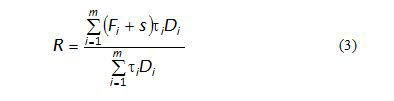
Swap spread is defined as the difference between a swap rate and the rate of an on-the-run treasury with the same maturity as the swap. The swap spread is the additional amount an investor would earn on an interest rate swap as compared to a risk-free fixed-rate investment.
Final practical notes
You can find more details at Interest Rate Swap
| 3.2 Interest Rate Amortizing Swap or Accreting Swap |
An amortizing swap is an interest rate swap whose notional principal amount declines during the life of the contract whereas an accreting swap is an interest rate swap whose notional principal amount increases instead. The notional amount changes could be one leg or two legs. To be generic, we assume that the notional amount changes apply to both legs. The analytics are similar to a vanilla swap except the national amount used per period may be different.
The present value of a fixed leg is given by

The present value of a floating leg can be expressed as
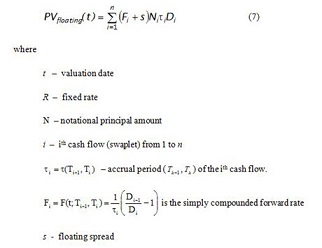
The final present value of the swap is
Practical notes
You can find more details at Interest Rate Amortizing and Accreting Swap
| 3.3. Compounding Swap |
A compounding swap consists of two legs: a regular fixed leg and a compounding leg. The compounding leg is similar to a regular floating leg except the reset frequency is higher than the payment frequency. For example, a compounding leg has 1 month reset frequency and 3 month payment frequency. The most popular compounding swap is Overnight Indexed Swap (OIS).
The present value of a compounding leg is given by
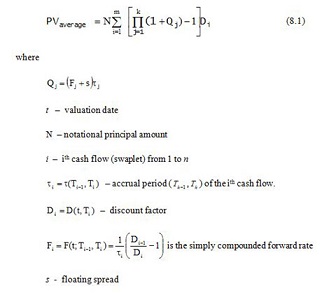
Here we assume that there are k reset periods within the i-th cash flow.
The present value of the fixed leg is the same as (1)
The final present value of the swap is

Practical notes
| References |